The risks of using AI to write your book
Having spent years working as a professional copyeditor and proofreader, the change I have noticed in my clients’ use of AI over the last couple of years has been dramatic. I completely understand the temptation – it can output what seems to be coherent, thoughtful prose in a fraction of the time it would take a human, reserving precious brainpower for other tasks. It can give suggestions to fix problem areas in your manuscript that you had struggled with for weeks.
AI certainly has its uses, provided it is being used in a specific, purposeful way, and any output is being thoroughly reviewed. The big problems come when authors’ temptation for AI to do all of the work gets too much, and it ends up being used to write whole sections, chapters, or even the full book!
Below is an example of a section of a manuscript I received from one of my clients.
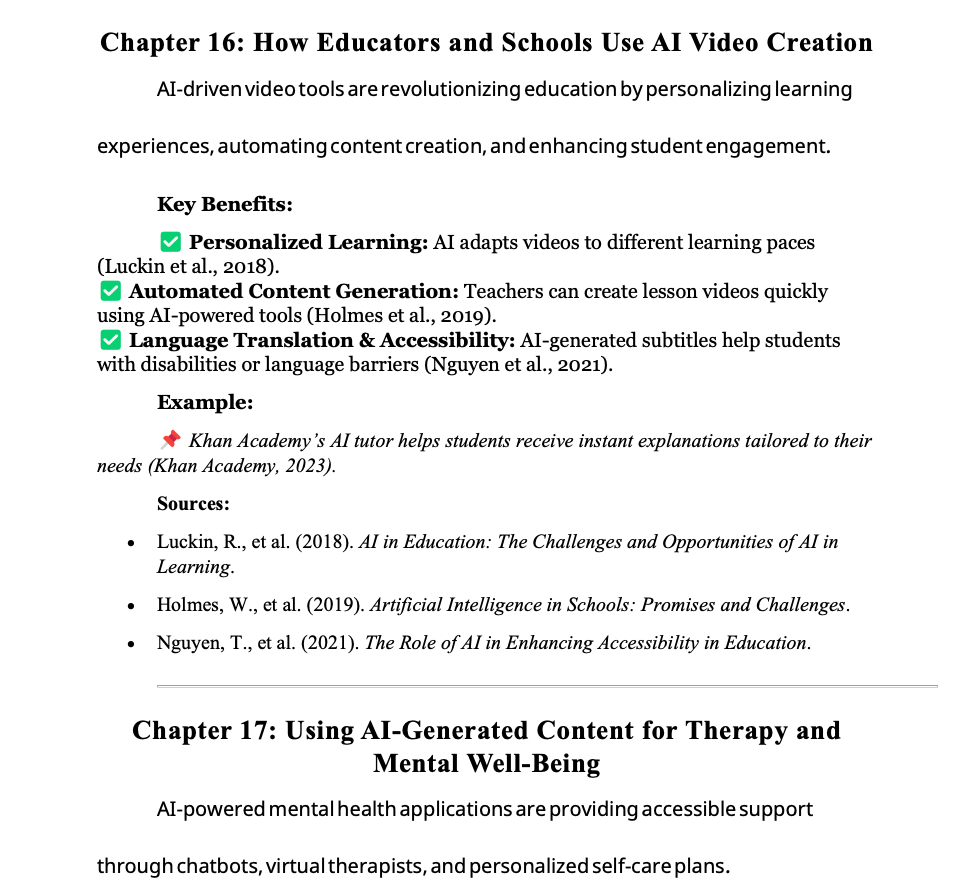
Ironically, this book was a guide to using AI to achieving financial freedom. I understood immediately that AI had been used to write the entire book. What issues can you see with the content here? I can see three main ones:
Depth/length
Formatting
References.
First of all, where is the content? Not including the sources section, the whole chapter is only 68 words long! As someone reading this section, you would be feeling pretty short-changed and underwhelmed. We only have one full sentence before being given a list of bullet points. Shorter chapters can be OK, but not this short. The other issue in this case was that other chapters in the book were over 5,000 words long. This is jarring to a reader as the balance between the lengths of chapters is completely off. Chapters don’t have to be exactly the same length throughout a book, but this is too much of a difference.
The other thing that immediately struck me was the formatting the AI had done. The spacing, use of different fonts and emojis instead of proper bullet points all gave the impression that this was not a serious piece of work. This took me a huge amount of time to strip out and reformat.
Finally, there is a wider question of the use of sources, and therefore the intended audience of the book. In the example, you can see that each bullet point has a reference, and these references have their own endnotes section at the end of the chapter, despite its comically short length. There has clearly been an instruction from the author for the AI to include references, but this gives an overly academic feel to what is an introductory book for beginners to AI. Including references and useful sources is absolutely fine, but have these at the back of the book so as to not distract from the content.
Editing
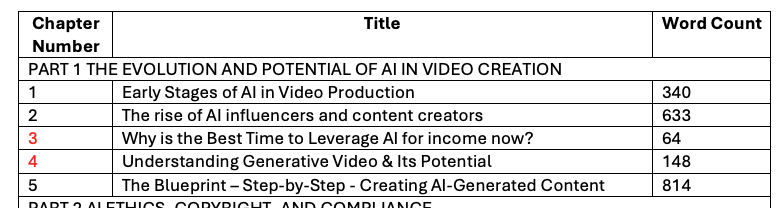
So, how did I start to tackle improving the original content? Firstly, I went back to the author with instructions for where extra content was necessary. I then supplied a full chapter plan, showing which shorter chapters could be merged to better balance the book:
After this, there were a number of development editing rounds where we refined the structure, and really questioned whether each chapter was offering something to the reader. Finally, once the manuscript was final, I did the formatting work – each paragraph and heading had a consistent style, emojis were banished and it was made ready for publication.
In summary, use AI as an author, but don’t let it get out of control. Most importantly, review ALL outputs and retain a critical view.
If you’re looking for professional copyediting and proofreading services for your novel or non-fiction book, please get in touch.